I want to develop world models that help us understand a traffic site as a whole: how road users interact, how risk emerges, and which predictions are useful for transportation decisions. My work connects drone trajectory data, multi-agent world models, and traffic safety, with a site-centric perspective complementary to ego-vehicle driving models.
From measuring conflicts to anticipating interactions
My earlier safety research combined anomaly detection and extreme value theory to study severe traffic conflicts. That work led me to a forward-looking question: before an interaction has finished, what can we say about how it will evolve and the risk it may create? ProSafeAV explores this question through world-model-based driving. My drone-data research asks it from the perspective of the traffic site.
Why I keep returning to drone data
Overhead trajectories put the visible road users into a shared spatial frame. They let me study a turning vehicle together with the cyclists, pedestrians, or vehicles around it, without choosing one vehicle as the centre of the problem. Intersections, roundabouts, and motorway segments offer different interaction settings. For me, these recordings are an empirical starting point for learning traffic dynamics, not a claim that overhead observations will always be available in deployment.
From a predictor to a model we can question
The initial goal was to learn plausible multi-agent futures. The harder question became what those futures justify. This has led to a connected set of studies: testing observation dependence, locating closed-loop failures, and checking whether prediction improvements actually help action ranking. A useful traffic world model needs to be evaluated for its intended use, not only for how closely it follows a recorded trajectory.
A transportation-oriented research direction
My long-term aim is to develop a complementary direction to ego-vehicle world models: models for understanding traffic interactions, prospective safety screening, and the validity of traffic digital twins. Traffic operations and infrastructure evaluation are motivating future applications. I am building this agenda through explicit tests of what the models can and cannot support. Recorded trajectories support observational tests; credible intervention claims require additional assumptions and evidence.
These studies form an ongoing research programme, connecting prediction accuracy, evaluation validity, and evidence that supports a decision. The research record lists published work, manuscripts under review, and ongoing projects separately. Current manuscripts →
Research projects
Status updated 22 September 2026. Submitted manuscripts are marked Under review; other active projects are marked Ongoing. See the research record for current manuscripts and published work.
Ongoing
World models from drone trajectories
GP-RSSM · Interaction graphs · Neural ODEs
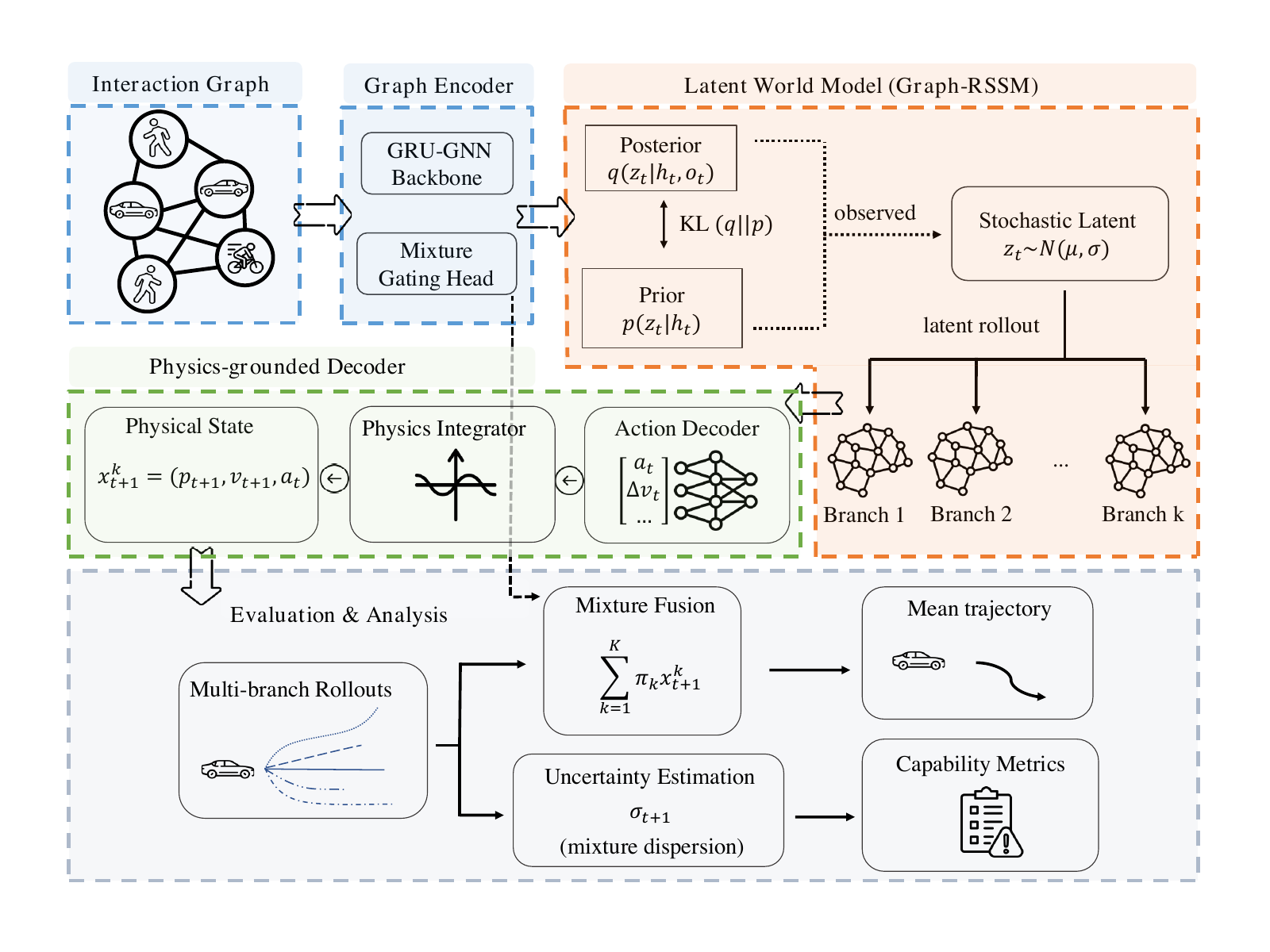
I explore site-centric world models that represent an entire traffic scene through interacting road users. The GP-RSSM line combines a graph-conditioned recurrent state-space model with a second-order neural ODE decoder and multimodal motion hypotheses. The aim is to model both interaction dynamics and uncertainty, while distinguishing observation-conditioned prediction from self-conditioned rollout.
Research focus. Graph-based temporal modeling, physically grounded trajectory decoding, and evaluation under full, partial, and prior-only observation grounding, using drone trajectory datasets including inD, rounD, and highD.
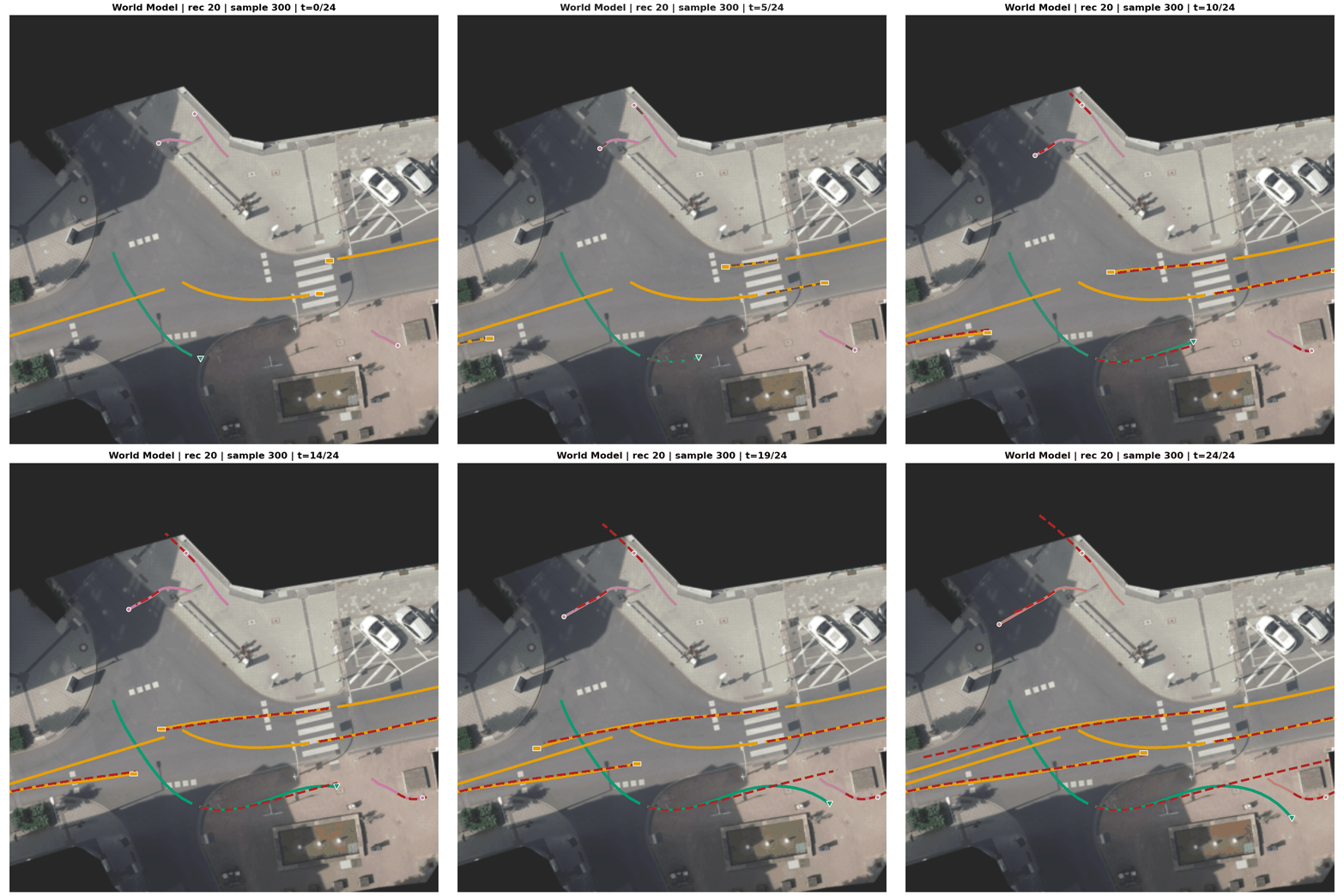
Prediction visualization from the GP-RSSM research code. Scene imagery and trajectories: inD / levelXdata. Dataset information. Click the figure to view it at full size.View the model architectureGraph-RSSM architecture from the author's trajectory world-model manuscript materials. Click the figure to view it at full size.
Scope. The animation is a qualitative prediction example on inD, not evidence of closed-loop control performance. World model here refers to trajectory-level traffic dynamics, rather than photorealistic video generation.
Under review · AAAI 2027
Understanding why closed-loop rollouts fail
Distribution shift · Error compounding · Controlled diagnostics
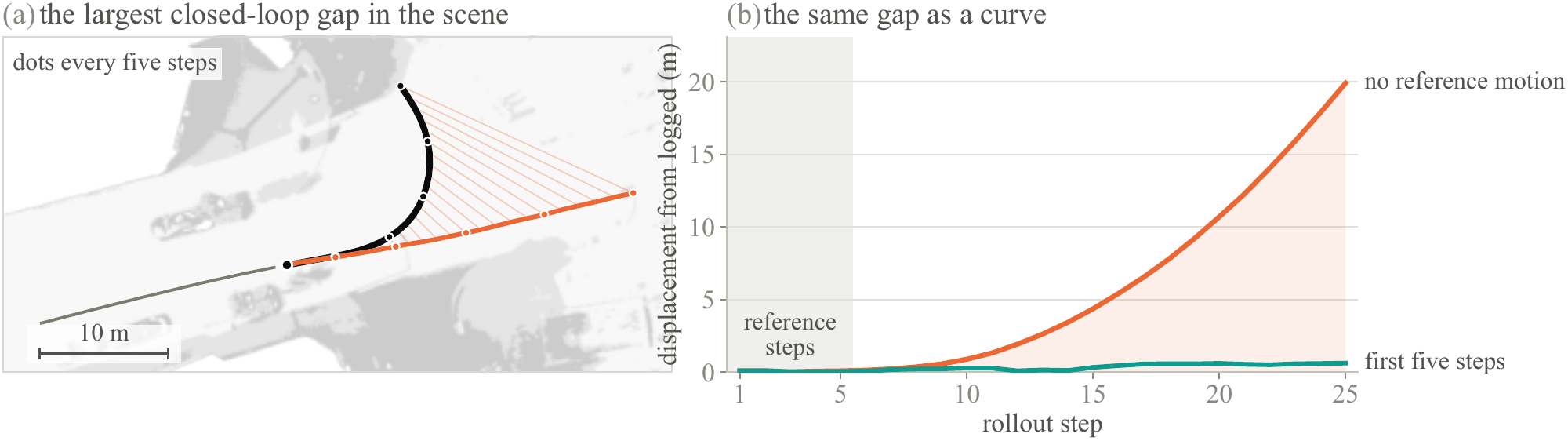
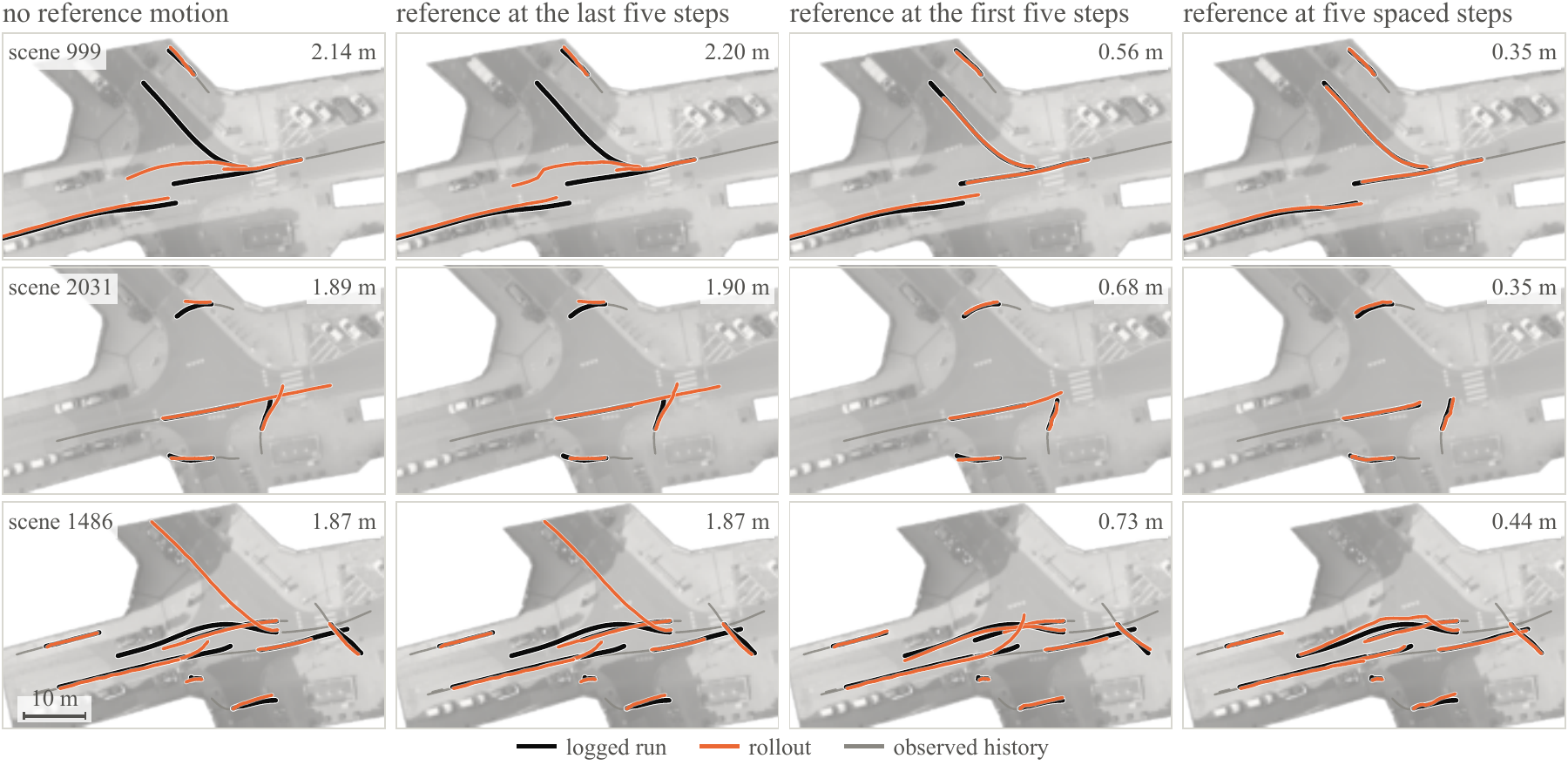
Accurate forecasts under logged inputs can deteriorate when a model consumes its own predictions. This study independently switches action and graph sources, then uses prefix interventions and matched-error temporal controls to investigate where the rollout gap originates and when it develops.
Research focus. A paired four-regime diagnostic, early-step replacement experiments, and temporal error controls. In the audited model family, action-source shift and early error accumulation explain much of the measured rollout gap; these findings are evaluated within the specified checkpoints and data protocol.
An illustrative inD validation scene from my rollout-diagnostics manuscript. Left: the agent with the largest closed-loop gap in the selected scene. Right: displacement from the logged trajectory, with and without a five-step reference prefix. This deliberately selected example illustrates error propagation; it is not an average-performance estimate. Imagery and trajectories: inD / levelXdata. Click the figure to view it at full size.Compare correction timing in three traffic scenesOriginal manuscript experiment figure: the Gaussian configuration on three selected inD validation scenes, with five logged motion inputs placed at the end, beginning, or evenly spaced through the rollout. Black denotes logged motion, orange the rollout, and grey observed history. ADE labels apply only to each displayed scene, not to the full validation split. Imagery and trajectories: inD / levelXdata. Click the figure to view it at full size.
Scope. The interventions diagnose model-internal behavior. They do not establish real-world causal effects or certify a planner's safety.
This work studies the gap between predictive accuracy and action-selection usefulness. Selectors receive the same action candidates built from observed history, lock their choices before reference evaluation, and are compared on recording-disjoint data. The protocol includes analytic motion anchors, learned controls, and explicit checks against future-information leakage.
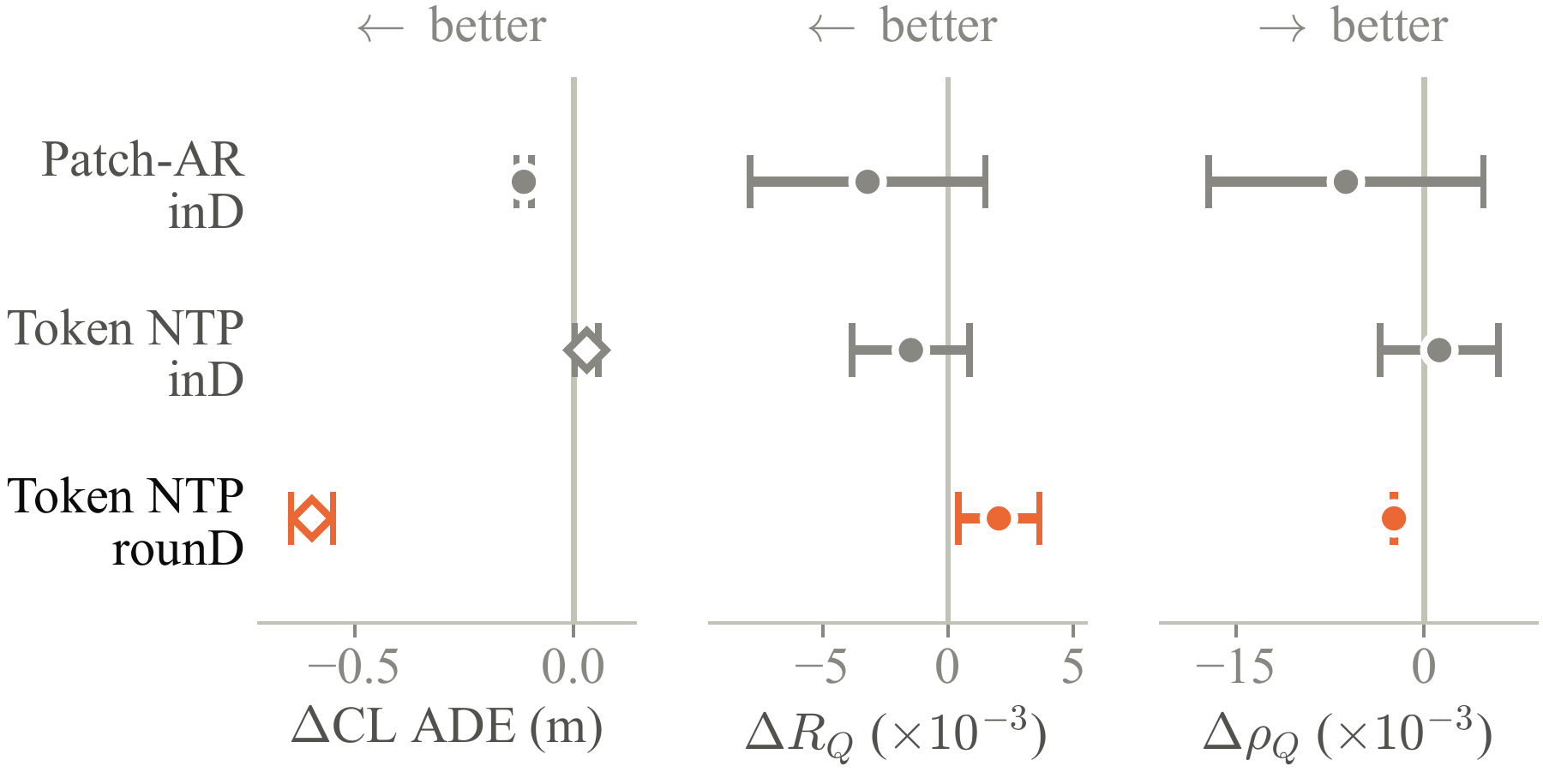
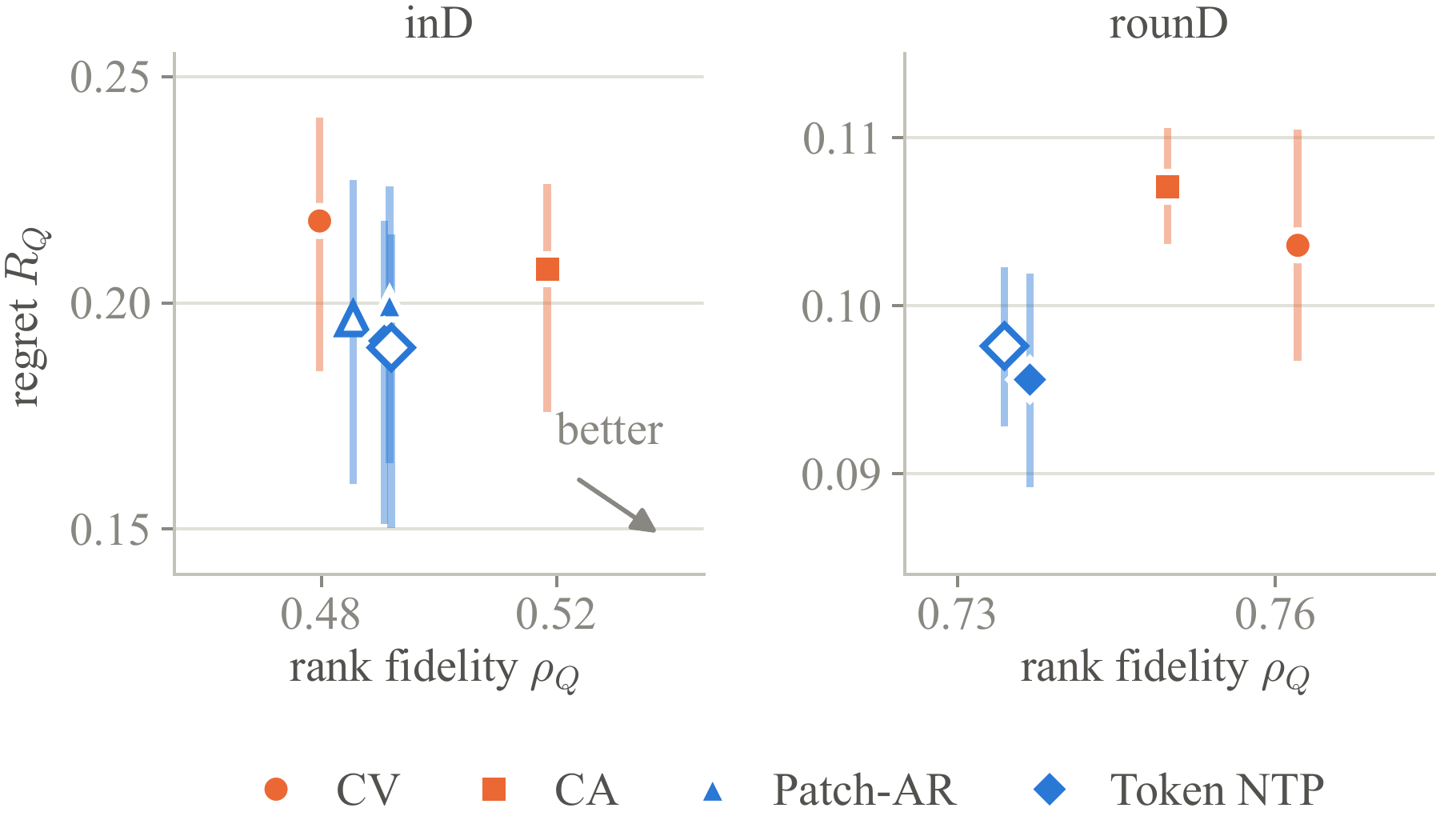
Research focus. A controlled candidate-ranking pipeline, rank-fidelity and regret measurements, and certificate-transfer tests. The study finds that improved closed-loop prediction does not consistently translate into better candidate ranking under the audited reference.
Prediction gains need not transfer to action ranking. Original manuscript results compare CAT-K-style training with behaviour cloning on the same adapted model family and fixed candidate bank. Lower prediction error (CL ADE) and regret (R_Q), and higher rank fidelity (rho_Q), are better. Circles show 95% recording-cluster intervals; open diamonds show training-seed standard deviations. The highlighted rounD comparison uses two confirmation recordings, so its utility intervals are descriptive. Click the figure to view it at full size.View the regret versus rank-fidelity comparisonOriginal manuscript results on 500 confirmation scenes per dataset, using the same future-free action bank for each selector. The preferred corner is lower right: lower regret and higher rank fidelity. CV and CA are constant-velocity and constant-acceleration anchors. Filled learned-model markers use behaviour cloning; open markers use CAT-K-style training. Vertical bars show 95% recording-cluster intervals, descriptive for the two-recording rounD split. Click the figure to view it at full size.
Scope. Driving-quality scores are simulator-relative surrogates. They are not on-road safety estimates, and the learned controls are local adaptations rather than official benchmark reproductions.
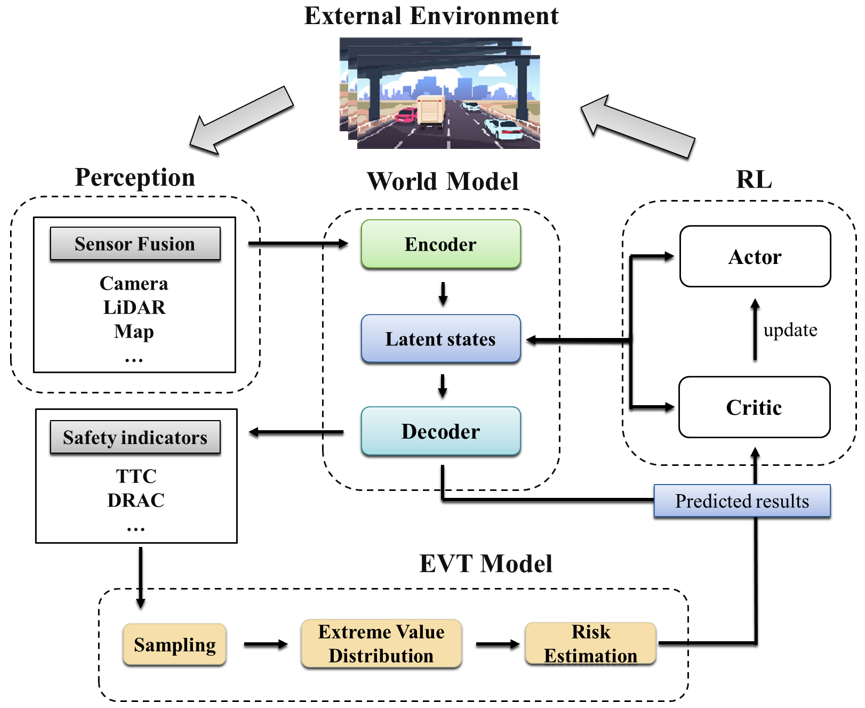
ProSafeAV explores a world-model-based reinforcement-learning framework that incorporates traffic-conflict indicators and extreme value theory. The research asks how predicted traffic interactions and tail-risk information can support proactive driving decisions. Implementation work uses a CARLA-based simulation environment and Dreamer-style latent dynamics.
Research focus. Research on the interface between latent prediction, surrogate safety indicators, tail-risk estimation, and policy learning. The project connects my earlier traffic-safety work with my current focus on world models.
Conceptual framework from the author's ProSafeAV manuscript materials. Click the figure to view it at full size.
Scope. The figure describes the research framework. The T-ITS manuscript under review is distinct from the 2025 conference contribution. CARLA policy-learning evidence and real-trajectory risk-model evaluation are separate; neither implies a real-world safety guarantee.
Surrogate safety · Information leakage · Tail diagnostics
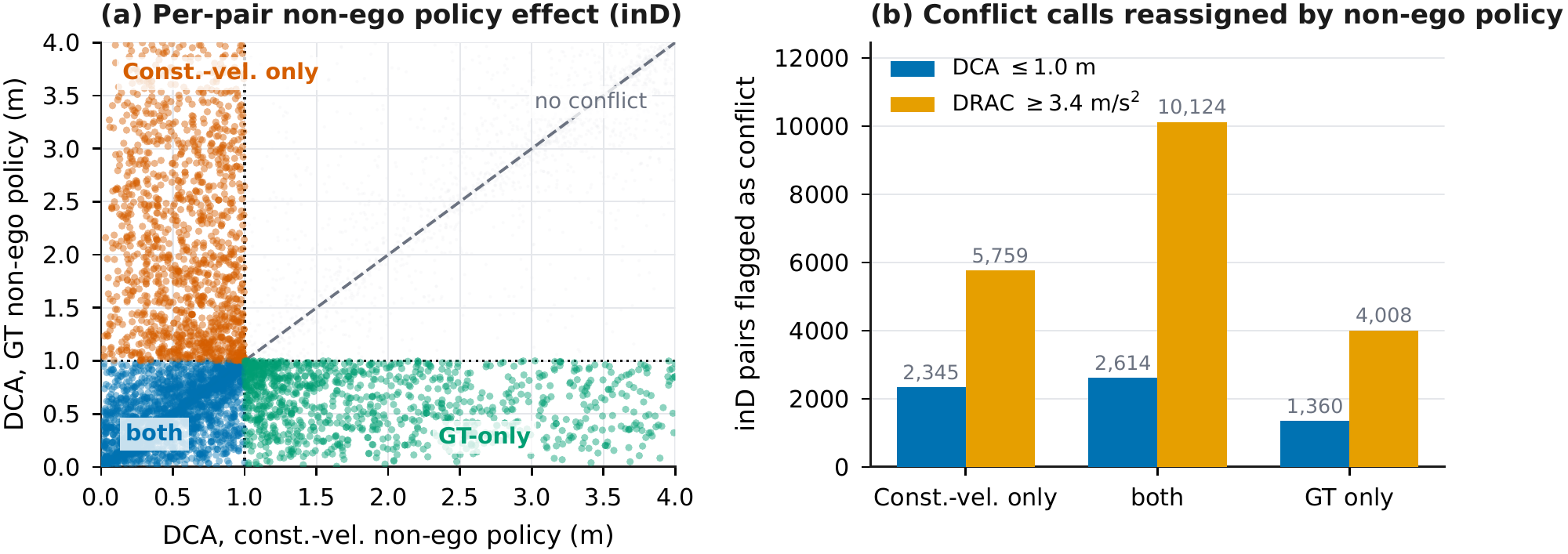
This research asks whether traffic forecasts can support site-level safety screening before an interaction has finished. Pairwise conflict indicators require a future for both road users. I therefore study not only the focal forecast, but also how surrounding agents' unknown futures are supplied, making the information available at prediction time explicit.
Research focus. Protocol development and pilot diagnostics across overhead traffic datasets, including time-to-collision, closest-approach, and required-deceleration indicators, event identification, and tail behavior.
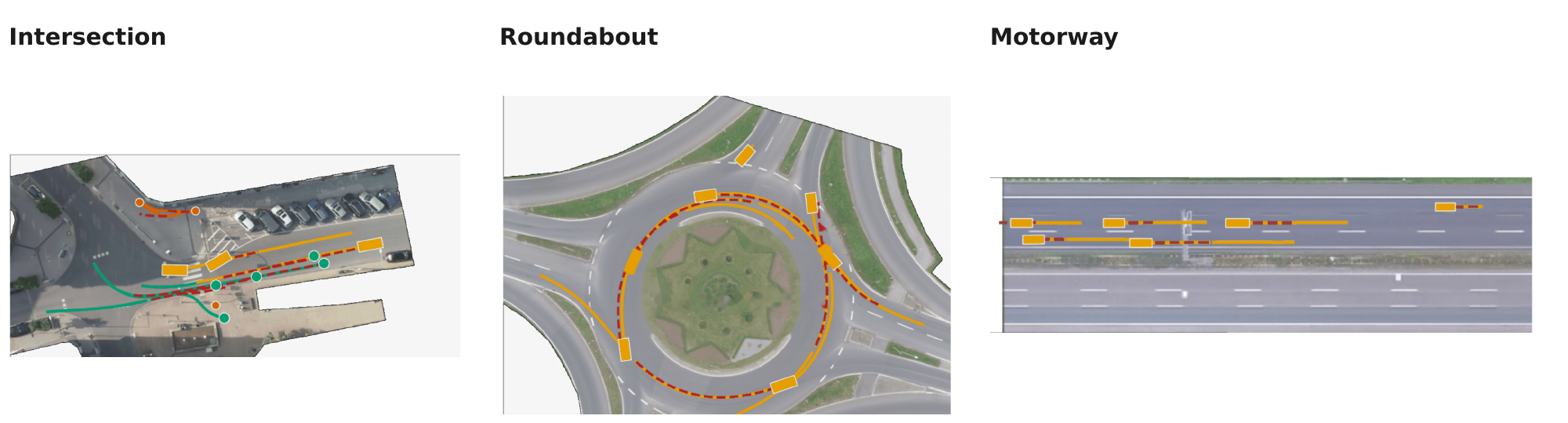
Original inD experiment from my forecast-driven safety manuscript. The focal forecast is held fixed while the surrounding agent's future is either extrapolated at constant velocity or taken from the recorded future (GT). Left: distance of closest approach (DCA) for the same ordered pairs. Right: pairs flagged by each policy at the stated DCA and required-deceleration (DRAC) thresholds. GT is an offline oracle diagnostic, not information available at prediction time. Counts are pair-level classifications, not crashes or independent events. Click the figure to view it at full size.View the traffic sites behind the safety studyOriginal site-context figure from the safety manuscript: intersection, roundabout, and motorway scenes. The overlays illustrate different interaction settings, not validated risk predictions. Scene imagery and trajectories: inD, rounD, highD / levelXdata. Click the figure to view it at full size.
Scope. This is ongoing protocol and pilot work. PET/MTTC components in the framework include proxy diagnostics; broader model comparisons and publication-grade tail-risk validation remain development goals.
Drone trajectories are useful observations, but recent motion can be incomplete. This study distinguishes two tests: replacing missing input history before encoding, and continuing a latent state with the learned prior while retaining earlier context. It asks whether the resulting degradation scores justify the same within-model or cross-model conclusions.
Research focus. A shared input-level comparison across forecasters, paired-scene analysis, and an explicit account of the context retained by each test. The work reframes the earlier TETHER study around evaluation comparability rather than an unconditional robustness claim.
Scope. Input-level missingness and an internal latent-pathway intervention are different evaluation objects. Reported robustness is conditional on the test, its severity, and the information available to the model.
Ongoing
Behavioral validity and cross-site generalization
Digital twins · Cross-domain evaluation · Behavioral validity
My recent work extends the evaluation question to calibrated traffic microsimulation and cross-site trajectory models. One line separates support, interaction selection, marginal distributions, and dependence in behavioral validity. Another compares graph-based and autoregressive learners across roundabout datasets under common information and map contracts.
Research focus. Layered behavioral diagnostics for calibrated twins and a common evaluation pipeline for graph-GRU, graph-RSSM, and token-autoregressive models across rounD and openDD.
Scope. These are ongoing studies. Observational realism, simulator-relative counterfactual evaluation, and real-world causal validity are treated as different questions.
Related public code
Traffic World Model is a separate public prototype for multi-site drone trajectory modeling with a Transformer, teacher-forced training, and open-loop rollout visualization. It is not the implementation for every project listed above. Additional public work is available on my GitHub profile.
Figures are drawn from my research manuscript and experiment materials. Dataset imagery remains attributable to its original provider; no raw trajectory dataset is distributed through this website.